Surface Mounted vs Recessed Protective TV Housings
Televisions are commonly used in behavioral health hospitals, psychiatric facilities and correctional facilities to provide patients with a source of information, comfort and a connection to the outside world. To ensure safe and durable service, proper television installation is required. You can compare all available options on our TV enclosure range
In typical commercial settings a TV is usually mounted using wall brackets that are fastened to an open wall. Such a method works well for indoor settings in domestic and commercial environments and in public spaces. However, when it comes to a sensitive environment, this is not always the best or safest solution. The reason being, open wall brackets as well as cables and fixings can act as a ligature point and or make the TV easy to remove from the wall.
Ligature-resistant TV enclosures are an ideal solution to these problems as they ensure the television is safely housed within a protective structural enclosure. When specifying such systems, architects and facility planners have the choice between surface mounted enclosures or recessed enclosures.
Understanding the difference between suspended and anchored systems is crucial in determining the most appropriate and safest method of installation for your facility.
Why Standard TV Mounts Are Not Suitable for Behavioral Health Facilities
Common to all standard TV mounts are exposed parts which are potentially problematic in a Behavioral Health environment. An example is shown here with the mounting arm and the connecting bracket as well as all the connecting cables, all unsecured and potentially able to be used by an adverse patient for self-harm.
Ligature concerns are a concern, but more of an issue with an exposed TV is that they can be easily knocked, have their cables pulled, or have their mounts or brackets adjusted. This can be a problem in high risk settings as it becomes a patient and family safety issue as well as an equipment safety issue.
The concerns mentioned are the primary reasons that behavioral health facilities refrain from using open TV installations. Secure television housings can be used as an alternative solution in such facilities.
To help safeguard your television and eliminate exposed mounting points that can pose a danger to you or others.
What Is a Surface Mounted Secure TV Housings
A Surface mounted TV housing is mounted directly to the wall surface. The enclosure sits off the wall and contains the TV in a steel protective cabinet.
Alternative option for installation. This option is preferred in old buildings where modifications to the wall surface are not allowed. The protection unit is fitted to the wall surface and the installation work is faster and with less structural adjustments.
Surface mounted units are commonly used in:
- Behavioral health hospitals
- Psychiatric patient rooms
- Detention centers
- Correctional institutions
- Rehabilitation facilities
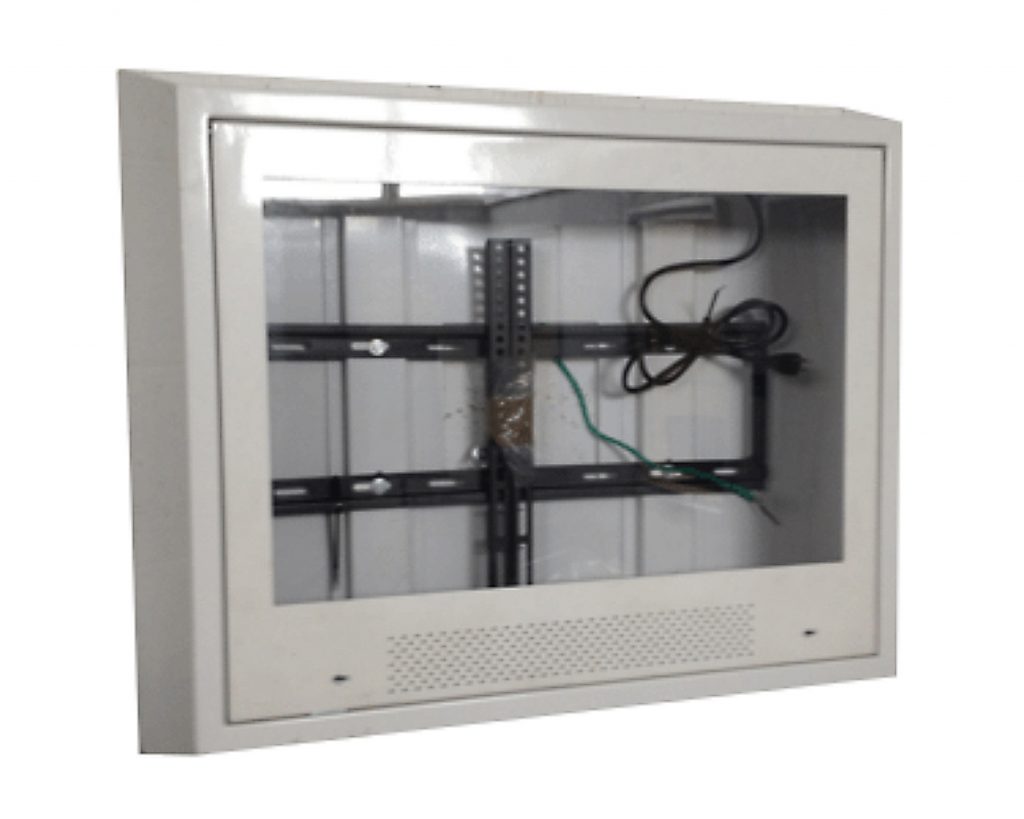
Standard surface mounted tv enclosures for behavioral health
The housing is externally mounted, has sloped surfaces and tamper proof hardware to preclude any ligature attachment points.
What Is a Recessed TV Housing
Recessed protective TV enclosures are fitted fully into the wall cavity, with no part other than the cables fitted to the front. Giving a lower profile and a more slim-line finish that is closer to the wall.
Recessed enclosures are frequently called out in new buildings and heavy renovation projects when the building structure can accommodate the placement of the enclosure into the wall cavity.
Recessed installations are often the choice of architects due to their nearly invisible nature in a building design. Our televisions can be easily built-in to the structure while still incorporating all of the required safety features necessary for a successful behavioral health application.
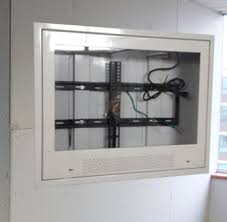
Similar to Surface Mounted versions, Recessed Enclosures are designed to eliminate any ligature points and to protect the TV from any type of impact or tampering.
Key Differences Between Surface Mounted and Recessed Housings
| Feature Surface Mounted TV Case | Recessed TV Case |
| Mounted directly to the wall | Recessed fully into the wall |
| Ideal use existing building & retrofits | New builds or renovations |
| Profile protrudes from the wall | Profile is flush with the wall |
| Faster installation | Requires wall preparation |
| Safety design ligature-resistant | Ligature-resistant |
Both of these types of enclosures are suitable for use in a behavioral health environment if properly specified.
Choosing the Right Option for Your Facility
It is not uncommon for the type of installation to change over the course of a project as the extent of the building’s structure is understood.
Surface mounted enclosures are the most common solution for new installations in patient rooms where the existing room is to be updated. They incorporate all the necessary anti-ligature features to ensure patient safety, whilst enabling the accommodation to remain usable with the minimum amount of structural alteration.
One common option for modern houses is to use a recessed enclosure. These are built into the structure of the building and so seem to merge in with the rest of the architecture.
These decisions are often made by Facility managers and architects during the design phase of a facility to ensure the appropriate configuration for the site and required level of safety.
Protecting Equipment and Reducing Maintenance
Another benefit of these protected housings is the safety and protection of the actual television. Oftentimes in behavioral health settings the environment can be quite tough on the TV and other electronics and when left exposed can be easily damaged, or even tampered with.
The protective shield protects the screen of the TV with a robust polycarbonate screen surface, and simultaneously prevents access to cables and attachment points, and also use of tamper-resistant fasteners in order to prevent easy removal of the TV.
Provides Protection This protective covering extends the lifespan of the piece and reduces the need for costly rebuilding and replacement.
Where Protective TV Housings Are Used
Both surface mounted and recessed behavioral health TV enclosures are used in a variety of secure environments, including: General Secure and High Risk Hostels Prisons Forensic Mental Health Settings and Care Homes.
- Behavioral health hospitals
- Psychiatric facilities
- Correctional institutions
- Detention centers
- Drug rehabilitation centers
- Veterans’ healthcare facilities
In these types of settings, televisions are an item that patients and residents are likely to want and will need to be assembled and installed in a safe manner.
Learn More About Behavioral Health TV Housings
Anti-ligature design is a set of design principles and specifications used in the manufacture of anti-ligature equipment for the protection of at risk people and the environments in which they live and work. Safe environments for people with challenging behaviours can be designed by managing environments to remove potential risks and hazards, providing safe and sensible access to televisions.
Related Behavioral Health Safety Guides
Complete Guide to Behavioral Health TV Casings
Protective TV Enclosure Installation Guide
Understanding Ligature Risk in Behavioral Health Facilities
Designing Safe Behavioral Health Patient Rooms