Common Safety Risks in Psychiatric Patient Rooms

Creating a safe environment in psychiatric patient rooms requires careful attention to detail. Every fixture, fitting, and installation must be considered in terms of how it may affect both patient and staff safety. Unlike standard healthcare or residential spaces, behavioral health environments must actively reduce risks while still remaining functional and supportive. Understanding the most… Read More »

Designing Safer Behavioral Health Facilities

Designing a behavioral health facility is very different from designing a standard healthcare or commercial building. Safety is not an added feature—it is built into every aspect of the environment. Behavioral health architects focus on reducing risks while maintaining functionality, comfort, and dignity for patients. One of the key considerations in this process is managing… Read More »

Why Anti-Ligature Equipment Matters in Suicide Prevention

Creating safe environments in behavioral health facilities is a critical part of suicide prevention. Every detail within a patient room must be carefully considered, from furniture and fixtures to how everyday items are installed and secured. One of the most important aspects of this approach is the use of anti-ligature equipment, which is specifically designed… Read More »

Risks of Standard TV Installations in Mental Health Facilities

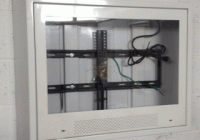
Discover why installing standard TVs in behavioral health, does not work. Televisions are widely used in mental health facilities to provide patients with structure, comfort, and access to information. Whether installed in patient rooms or shared spaces, they can play a positive role in supporting daily routines. However, the way televisions are installed in these… Read More »

Why Hospitals Are Moving to Safer TV Installations

Ligature-resistant TV protection, the new Behavioral Health Upgrade. Psychiatric hospitals are continuously evolving to improve patient safety, staff protection, and overall facility design. One area that has seen significant attention in recent years is the installation of televisions within patient rooms and shared spaces. While televisions provide clear benefits—offering comfort, routine, and access to information—they… Read More »

How TV Enclosures Improve Safety in Patient Rooms

In behavioral health units, safety is not an afterthought—it is built into every detail of the environment. From door hardware to furniture, each element must be carefully selected to reduce potential hazards while maintaining a functional and supportive space for patients. Televisions are commonly used in these environments to provide structure, relaxation, and access to… Read More »

What Is a Behavioral Health TV Enclosure and Why They Need Them

Secure TV Enclosures play an essential part in Behavioral health safety, as recommended by The Joint Commission. Televisions play an important role in behavioral health facilities, psychiatric hospitals, and secure healthcare environments. They provide patients with access to structured programming, relaxation, and a sense of routine during treatment. However, while televisions offer clear benefits, they… Read More »

Autism TV Protection Cabinet: Creating Safer Spaces for Individuals with Autism

It is a primary concern in all settings serving people with autism – safety, comfort. Our protective TV covers shield vulnerable unsupervised televisions in residential care settings, special education classrooms and schools, therapy centers and behavioral health facilities. Unexpected bumps, pokes, prods and other harmful acts by people with autism can mark, crack and even… Read More »

Changes to Ligature Risk Guidance in Behavioral Health Facilities

Over the past several years, I’ve worked with behavioral health facilities across different states reviewing their environmental risk profiles. One thing has become very clear: ligature risk guidance is no longer static. It is evolving — and it’s evolving quickly. Many facilities assume that once a building has passed inspection, it is “done.” That used… Read More »